| Sl. No. | Contents | ContactHours |
| 1 | Introduction to Operating Systems, UNIX: What operating systems do; Operating System structure; Operating System Services; User - Operating System interface; System calls; Types of system calls; Operating System structure; Unix | 8 |
| 9. Course Outcome: | After completion of the course the students will be able to:CO1 Understand the concept and design issues associated with an operating system.CO2: Identify the problems related to process management, synchronization and apply learned methods to solve basic problems.CO3. Explain the basics of memory management and the use of virtual memory in modern operating systems.CO4. Understand the concept deadlock avoidance, prevention, and detections techniques.CO5: Implementation of process management, memory management and file management using system calls.CO6: Analyze the data structures and algorithms used for developing an operating system. |
| command: CommandStructure, Internal and External commands, filters; vi editor. | ||
| 2 | Process Management: Process concept; Operations on processes; Multithreading models; Threading issues. Process Scheduling: Basic concepts; Scheduling criteria; Scheduling algorithms; Multiple-Processor scheduling; Thread scheduling.Process Synchronization: Inter-process communication; Synchronization: The Critical section problem; Peterson’s solution; Synchronization hardware; Semaphores; Classical problems of synchronization. | 10 |
| 3 | Deadlocks: Deadlocks: System model; Deadlock characterization; Methods for handling deadlocks; Deadlock prevention; Deadlock avoidance; Deadlock detection and recovery from deadlock.Memory Management: Memory Management Strategies: Background; Swapping; Contiguous memory allocation; Paging; Structure of page table; Segmentation. Virtual Memory Management: Background; Demand paging; Page replacement; Allocation of frames; Thrashing | 10 |
| 4 | File System, Implementation of File System: File System: File concept; Access methods; Directory structure; Protection. File system structure; Directory implementation; Allocation methods; Free space management.Secondary Storage Structures: Mass storage structures; Disk structure; Disk scheduling; Disk management; Swap space management. Protection: Goals ofprotection, Principles of protection, Access matrix. | 8 |
| 5 | Shell Programming: Shell scripts, Running script in the current shell, Pattern Matching, Redirection, String handling, Conditional Parameter Substitution, Shell functions.Case Study: The Linux Operating System: Linux history; Design principles; Kernel modules; Process management; Scheduling; Memory management; File systems, Input and output; Inter-process communication. |
- Teacher: PRAMOD MEHRA
|
Sl. No. |
Contents |
Contact Hours |
|
1 |
Unit 01: Data Science History, Data Science and Related Terminologies, Types of Analytics, Applications of Data Science, Data Science Process Models. Introduction to AI, History and Foundation of AI, Intelligence, and it’s type, Categorization of Artificial Intelligent based System, Agents & Environments, Applications, and Current trends in AI
|
10 |
|
2 |
Unit 02: Introduction to Data, Types, Data Preprocessing, Understanding Data Requirements, Dealing with Erroneous/Missing Values, Standardizing Data, Steps involved in EDA using Python Programming/R. Knowledge and Reasoning in AI: Knowledge based Agents, Syntax and Semantics, Forward Chaining, Backward Chaining, Knowledge Engineering, Belief Network |
10 |
|
3 |
Unit 3: Introduction to Modelling Techniques, Supervised Learning Algorithms- Regression, Classification, and Unsupervised Learning Algorithms- Clustering, Association Rule Mining Feature Selection, Dimensionality Reduction, Independent and Dependent Variables, Relationship between Variables: Correlation, Multicollinearity, Factor Analysis, Treatment of Outliers |
10 |
|
4 |
Unit 4: Problem Solving Agent, Formulating Problems, Example Problems, Uninformed Search Methods, Informed Search Method, Local Search Methods, Genetic algorithms, Adversarial Search |
10 |
|
5 |
Unit 5: Applications of Analytics in Healthcare, Applications of Analytics in Agriculture, Applications of Analytics in Business, Applications of Analytics in Sports, Forms of Learning, Introduction to Expert Systems, Expert System Architecture, Capstone Project |
8 |
|
|
Total |
48 |
- Teacher: Shailendra Narayan Singh
Computer Networks-I course designed for V Sem CSE Sec-E students
- Teacher: Vishal Trivedi
CO1: Understand the different issues involved in the design and implementation of a
database system.
CO2: Study the physical and logical database designs, database modeling, relational,
hierarchical, and network models.
CO3: Understand and use data manipulation language to query, update, and manage a
database.
CO4: Develop an understanding of essential DBMS concepts such as: database security,
integrity, concurrency.
CO5: Design and build a simple database system and demonstrate competence with the
fundamental tasks involved with modeling, designing, and implementing a DBMS.
CO6: Evaluate a business situation and designing & building a database application
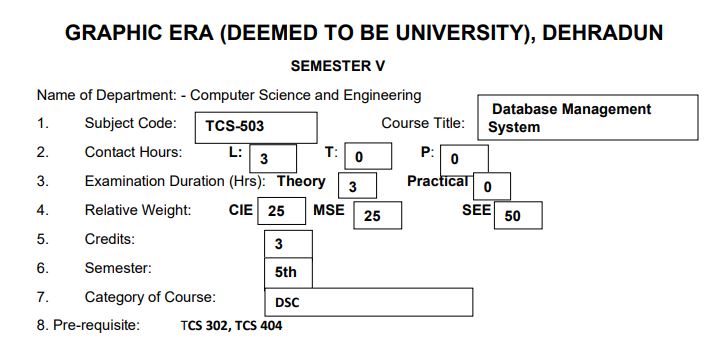
- Teacher: MOHD REHAN GHAZI
Hello Everyone!!!
Welcome to the fascinating world of Computer Networks—the invisible technology that powers everything from WhatsApp messages and UPI payments to Google searches, Netflix streaming, online gaming, and cloud computing.
By the end of this course, you will understand how billions of devices communicate seamlessly across the globe and appreciate the engineering behind the digital world we use every day. Computer Networks is one of the most sought-after subjects in campus placements, forming the foundation for careers in Software Development, Cloud Computing, Cybersecurity, DevOps, AI, IoT, and Network Engineering. Learn this subject with curiosity and dedication, and you won't just prepare for examinations—you will build the knowledge and confidence needed to solve real-world problems and excel in the technology industry.
After completion of the course, you will be able to:
CO1: Familiarize with fundamental underlying principles of computer networking and functionality of layered network architecture
CO2: Evaluate and Select the most suitable Application Layer protocol (such as HTTP, FTP, SMTP, DNS, BitTorrent) as per the requirements of the network application and work with available tools to demonstrate the working of these protocols
CO3: Model a problem or situation in terms of layering concept and map it to the TCI/IP stack
CO4: Design a Reliable Data Transfer Protocol and incrementally develop solutions for the requirements of Transport Layer
CO5: Articulate, analyze and appraise the TCP protocol
CO6: Describe the essential principles of Network Layers, design the network layer requirements using both IPv4 and IPv6 and understand the supporting IP protocolsSyllabus of the Course:
Unit
1-Introduction: Computer Networks and the Internet, Overall view: As
components and as services; What is a protocol, What is a network protocol,
Access Networks and Physical Media, Circuit and Packet Switching, Internet
Backbone, ISPs and Interconnection of ISPs, Delay, Loss, and Throughput in
Packet-Switched Networks, The Layered Architecture: Protocol Layering, The OSI Reference Model and the
TCP/IP protocol stack
Unit 2-Application Layer1: Principles and Architectures of Network Applications, Client and Server processes, the idea of socket, Transport services available to Application layer Application Layer Protocols: The Web and http: Persistent and Nonpersistent connections, http message format, User-Server interaction: cookies, proxy server, conditional GET Email: smtp, mail message formats, accessing mails using http and imap DNS: Services, How it works, Root, Top-Level and Authoritative DNS servers, DNS caching, Recursive and Iterative queries, DNS Records and messages, P2P architecture: Scalability, BitTorrent protocol
Unit 3-Application Layer2: Video Streaming and Content Distribution Networks, HTTP Streaming and DASH, Content Distribution Network
Transport Layer1: Introduction, Relationship between Transport Layer and Network Layer, Multiplexing and Demultiplexing work of Transport Layer, Connectionless Transport: UDP- Segment Structure of UDP, Checksum
Unit 4-Transport Layer2: Principles of Reliable Data Transfer, Building a reliable data transfer protocol using FSM, stop-and-wait, Go Back N, Selective Repeat, Connection Oriented Transport TCP: Connection Establishment, TCP segment structure in detail, Round Trip Time Estimation and Timeout, TCP Flow Control, TCP Congestion Control: Slow start, Congestion Avoidance, Fast Recovery, Introduction to QUIC: Quick UDP Internet Connections
Unit 5-Network Layer I: Introduction, Network Service Model, The Internet Protocol(IP), IPv4 Datagram format, DHCP, Network Address Translation (NAT), A brief introduction to routing protocols, RIP and OSPF.
Network Programming: Sockets-Address structures, TCP sockets, creating sockets, bind, listen, accept, fork and exec function, close function; TCP client server: Echo server, Elementary UDP sockets: UDP echo server
Textbook:|
Jim Kurose and Keith Ross |
Computer Networking-A Top Down Approach |
8th Edition |
Pearson Education |
2022 |
Reference Books:
|
Authors Name |
Title |
Edition |
Publisher, Country |
Year |
|
Andrew Tanenbaum, Nick Feamster and David J. Wetherhall |
Computer Networks |
6th Edition |
Pearson Education |
2022 |
|
Behrouz A. Forouzan and Firouz Mosharraf |
Computer Networks: A Top-Down Approach |
Standard Edition |
McGraw Hill |
2023 |
- Teacher: Dr. Pradeep Bedi